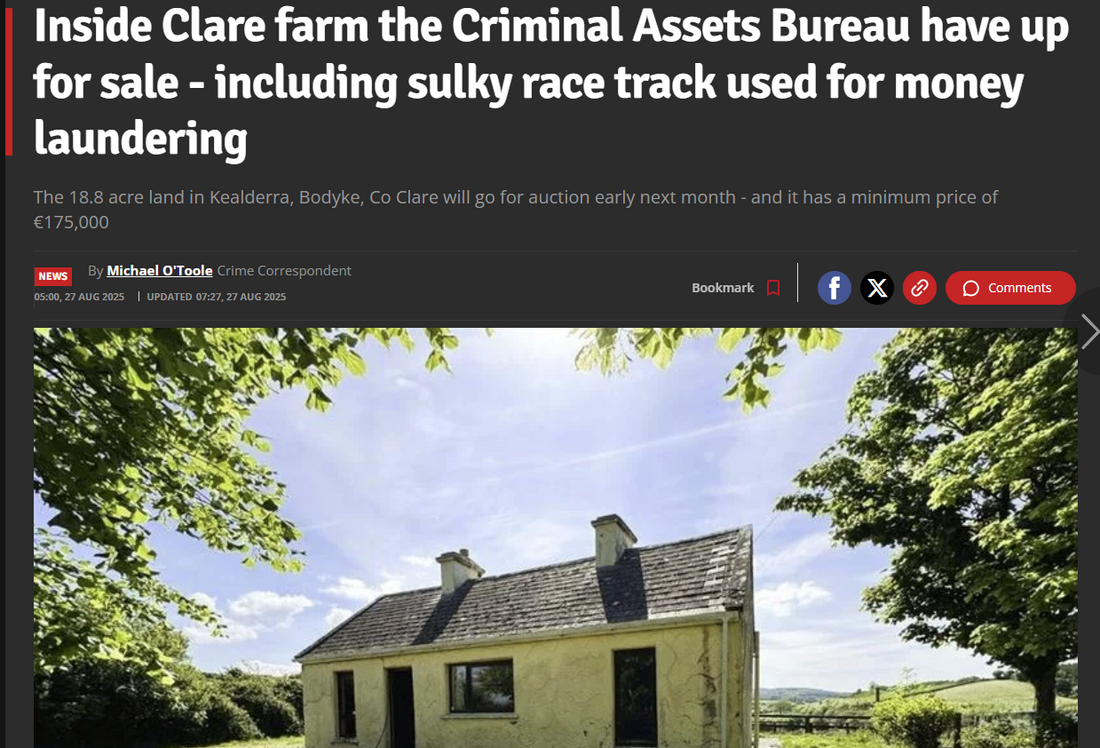
 Inside an Irish Money Laundering Operation: A Case Study
When Gardaí raided a remote farm in County Clare, they didn’t just uncover livestock and machinery—they unearthed a sophisticated money laundering scheme that had quietly converted criminal proceeds into assets that looked, on the surface, perfectly legitimate. This case illustrates a classic Irish money laundering typology, showing how criminals place, layer, and integrate illicit cash within Ireland’s financial and property systems. Placement: Converting Cash into Tangible Assets The operation began with large volumes of cash generated from drug trafficking and organised crime. Instead of depositing the money directly into banks, where suspicious transaction reports (STRs) might be triggered, the criminals purchased agricultural land, machinery, and livestock. By acquiring a functioning farm, they could explain away large cash movements as agricultural income. This is a common Irish adaptation: cash-rich illicit groups investing in rural property or cash-intensive businesses (such as pubs, car washes, or construction firms) to disguise their income sources. Layering: Complex Transfers and False Trails Once the farm was operational, transactions became deliberately complex. Animals were bought and sold across county lines, often with inflated or understated valuations. Equipment was leased through third parties, and funds were moved across multiple Irish bank accounts in amounts just under the €10,000 reporting threshold. The criminals also relied on “money mules”—individuals, often vulnerable or indebted, who allowed their accounts to be used for funneling funds. This layering process created a tangled financial trail, frustrating investigators trying to trace the money back to its illicit origins. Integration: Dirty Money Becomes ‘Clean’ Over time, the scheme succeeded in integrating illicit funds into the mainstream economy. The farm produced legitimate revenue streams: cattle sales, EU agricultural subsidies, and lease agreements. Criminal proceeds were effectively rebranded as farm income. The perpetrators then used these seemingly legitimate profits to invest in vehicles, luxury goods, and even overseas property. By this stage, the money appeared clean—making it extremely difficult to prove its criminal origin without extensive investigation. This case demonstrates several AML red flags relevant to Ireland:
The case was eventually cracked by the Garda National Economic Crime Bureau (GNECB), working in partnership with the Criminal Assets Bureau (CAB). Assets—including the farm, machinery, and livestock—were seized under proceeds of crime legislation. Under the Criminal Justice (Money Laundering & Terrorist Financing) Act 2010, amended in line with EU directives, individuals convicted of laundering can face up to 14 years in prison and unlimited fines. In addition, the Central Bank of Ireland can levy significant administrative sanctions against financial institutions that fail to detect and report suspicious activity. This farm case typifies money laundering typologies in Ireland: criminal cash embedded in rural businesses, layered through complex transactions, and integrated into the economy via legitimate-looking revenue. For compliance officers, solicitors, accountants, and financial institutions, it serves as a reminder that criminal proceeds don’t always appear as stacks of cash in city banks—they may be hiding in plain sight on a quiet farm road in the Irish countryside. Source: https://www.irishmirror.ie/news/irish-news/crime/gallery/inside-clare-farm-criminal-assets-35794821
0 Comments
Money laundering network run by Russian millionaires and linked to Kinahan gang is exposed5/12/2024  Thank you to our money laundering typology guest contributor who is a senior AFC professional working in Ireland on international financial crime matters. This person freely gives time to source interesting typologies and analyses them for our visitors. Contact us if you would like to do likewise, whether anonymous or credited.
Money laundering network run by Russian millionaires and linked to Kinahan gang is exposed
Summary i. A sophisticated money laundering network operated by Russian millionaires was dismantled in a global law enforcement operation. The network was closely linked to the Kinahan crime cartel, a notorious organized crime group, and facilitated laundering billions of euros in illicit funds. ii. The network's operations centered around two entities, Smart and TGR, which provided services to exchange physical cash for cryptocurrency. This allowed criminals to obscure the origins of the funds effectively, bypassing traditional financial systems and anti-money laundering controls. iii. The laundering operation had a vast international footprint, making it one of the most complex cases tackled in recent years. The involvement of high-net-worth individuals and cross-border connections highlighted the challenges in combating such networks. iv. The coordinated efforts led to 84 arrests and the seizure of £20 million (€24 million) in assets in the UK alone. Authorities hailed it as the National Crime Agency's largest money laundering operation of the past decade. v. The case underscores the evolving techniques criminals use, particularly leveraging cryptocurrencies to bypass scrutiny. It also demonstrates the importance of international collaboration in targeting transnational financial crimes. What’s interesting i. The most notable and interesting aspects for AML professionals from this article include:
ii. This case is a stark reminder of the need for constant adaptation, training, and the adoption of advanced technologies to stay ahead of evolving criminal methodologies. Source: https://www.breakingnews.ie/ireland/money-laundering-network-run-by-russian-millionares-and-linked-to-kinahan-gang-is-exposed-1704190.html 
1. What Happened? It seems that the Criminal Assets Bureau (CAB) is facing a significant challenge in accessing €345 million in Bitcoin seized from Crumlin drug dealer Clifton Collins. The Bitcoin, originally valued at €53 million when seized in 2019, is locked away in 12 digital wallets, with the keys to access them reportedly missing. Collins created 12 wallets for storing the bitcoin and recorded the codes, or digital keys, for each in a document. Collins decided it would be safer to disperse his growing fortune across multiple virtual wallets that hold the cryptocurrency. The Bitcoin was uncovered by the Garda after an operation targeting Collins (in 2019) when it was valued at €53 million. Garda has effectively been sitting on the asset, hoping advances in technology will lead to it being unlocked, it has soared in value to €345 million. Collins – a 53-year-old former beekeeper – grew cannabis crops in rented houses and sold the harvested drug to criminals, including in his native Crumlin. He was apprehended in 2017 after a cannabis growing operation was discovered by chance after years of operating under the radar. Gardaí on a routine patrol spotted a car parked at Military Road near Sally Gap in Co Wicklow in the early hours of the morning and went to check on it. Cannabis herb valued at €2,000 was found in the car, driven by Collins. A subsequent investigation discovered he had been using three rented houses – in Galway, Meath and Longford – to grow cannabis. In the property in Galway, gardaí discovered a crop valued at €400,000 and Collins was later jailed for five years. Eventually the Irish High Court ruled that the Bitcoin was derived from criminal activity. While Collins had handed over some Bitcoin and a code to a portion of his stash, the bulk remains inaccessible due to the lost key, which was hidden in a fishing rod that has since gone missing. Collins invested some of the proceeds of his drugs business in bitcoin, when it was worth only a fraction of its current value, in 2011 and 2012. As the virtual currency increased in value, Collins decided it would be safer to disperse his growing fortune across multiple virtual wallets that hold the cryptocurrency. The keys for the 12 wallets were written on documents and then hidden in a fishing rod case at one of his rented properties, in Co Galway. In interviews with gardaí he claimed he never saw the case again after a break-in at his home. However, a clear-out of the property after his arrest may also have resulted in the loss of the document. In late 2020, Collins surrendered assets worth €1.2 million to the State as they were the proceeds of crime. They included €1 million in bitcoin, which he had the key codes for, as well as a two-seater Gyro aircraft, a camper van and a fishing boat. Despite the value of the Bitcoin skyrocketing, CAB is hopeful that advances in technology will eventually allow them to unlock the wallets. In the meantime, they have liquidated other assets and sold accessible Bitcoin to benefit the state. Collins remains a significant case for the CAB, marking him as their largest financial loss to date. The outcome of this situation will depend on future technological developments or the recovery of the missing key. Pursuing Bitcoin as the Proceeds of Crime is not new The Chief Bureau Officer of CAB informed Irish media way back in October 2021 that CAB is targeting the seizure of cryptocurrencies, however, the value of cryptoassets can be difficult to realise. Back then Detective Chief Superintendent Michael Gubbins said cryptocurrency plays a part in some of the assets that CAB has seized and while there is a substantial value to the cryptocurrency, "we just don't have the keys to get that". 2. What’s interesting?
Source:
|
AuthorOn this page you will find a selection of links to articles useful for AFC training. Archives
September 2025
Categories
All
|
 RSS Feed