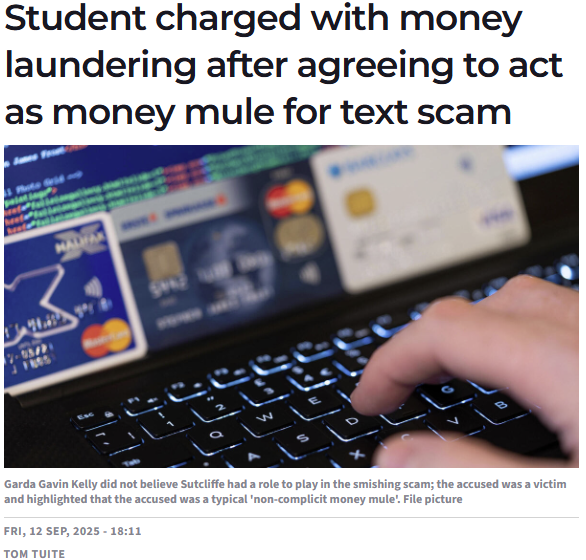
 Student charged with money laundering after agreeing to act as money mule for text scam [September 12, 2025]
Summary: i. A 20-year-old student, Darragh Sutcliffe, pleaded guilty to money laundering after agreeing to act as a money mule for a “smishing” (text phishing) scam. He had no prior convictions. At the time of the offence, he was planning to sit accountancy exams. ii. Between 23-25 May 2023, €16,350 in fraudulently obtained funds from smishing scams were deposited into his account in four separate transactions. €9,350 came from one victim (Cork woman) via an “E-flow text scam” after she responded to a malicious message. Another €2,000 from a Killarney resident. iii. Sutcliffe withdrew about €3,500 from ATMs in Lucan before his bank froze his account. After his account was flagged, he went to Gardaí and made a false report to try to distance himself from the transactions. The banks reimbursed the victims, except AIB remained out €3,500 (the ATM withdrawals). iv. In court, his solicitor emphasised that he was a typical “non-complicit money mule” — i.e. someone who allows just their account to be used on promise of payments which never materialised. v. He’ll repay the stolen funds, was contrite, has family support; sentencing has been adjourned until February. The judge also ordered a €5,000 donation to a cancer charity. 2. What’s interesting: i. Money mule risk & identification
iii. Bank account usage, transaction monitoring, freezing mechanisms
iv. False reports / attempts to distance oneself
v. Financial harm & liability:
vi. Education & awareness as mitigation
vii. Sentencing & regulatory implications
Source: https://www.irishexaminer.com/news/arid-41704397.html
0 Comments
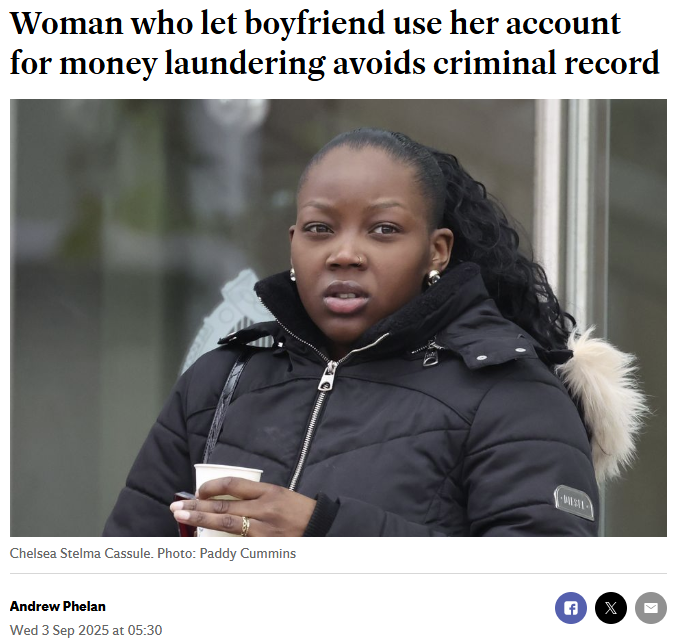
Very good AML typology on money mules and goes to show that highly educated people can be sucked-in to money laundering. I posted about it on Linkedin here and a guest contributor also wrote a detailed piece here. Noting this person's background of a business degree and work at an airline and tech company, quite possible that a career in financial services may be on the cards. That is certainly not over, but there will be a big hurdle to clear because the fact that no conviction was recorded doesn't mean that the person does not have to disclose it, It will raise concerns about judgement with a potential future regulated financial services provider employer. ➡️ A business graduate who let her “con-artist boyfriend” use her bank account to launder money has been spared a criminal record. ➡️ Chelsea Stelma Cassule (25) had been taken into her then partner’s trust when she gave him access to her account, which was used to transfer the €300 proceeds of a fraud. ➡️ Judge John Hughes struck the case out at Dublin District Court after hearing she had made a €300 charity donation and a probation report put her at a “low risk” of reoffending. ➡️ Cassule, of Brabazon Hall, Cork Street, Dublin 8, had pleaded guilty to money laundering – possession of the proceeds of criminal conduct. ➡️ Cassule had no previous convictions. ➡️ A defence barrister said the third party was Cassule’s boyfriend at the time. He told her he had a job opportunity in Belfast and was going to move there but needed a deposit and asked to use her account. ➡️ She did not know her boyfriend was defrauding anyone but in the cold light of day, she accepted the story was “a little bit fanciful”, the barrister said. ➡️ The accused had a business degree and had worked for an airline and a tech company. ➡️ Judge Hughes said Cassule had been “a victim of this herself” and had not made any financial gain. Her “con-artist boyfriend” had “taken her into his trust” and her suspicions were lowered, but she “should have known better”, the judge said. ➡️ The accused had an otherwise “unblemished” record. Source: https://www.independent.ie/irish-news/courts/woman-who-let-boyfriend-use-her-account-for-money-laundering-avoids-criminal-record/a1373019726.html
Woman who let boyfriend use her account for money laundering avoids criminal record [September 3, 2025]
1. Summary: i. A business graduate allowed her “con-artist boyfriend” to use her bank account for money laundering. ii. She was spared a criminal record in relation to that offence. iii. Her defence emphasised that she had been manipulated / misled by her partner, and that her involvement was passive (i.e. letting use of account rather than actively operating the laundering) and that she did not profit. iv. The court considered her personal circumstances (e.g. being misled, her lack of awareness of full criminality) when deciding to not impose a criminal record. 2. What’s interesting: i. Non-complicity / Naivety” defence
ii. Risk of insiders or account holders being exploited
iii. Court leniency & thresholds for criminal record
iv. Implications for account monitoring / KYC / due diligence
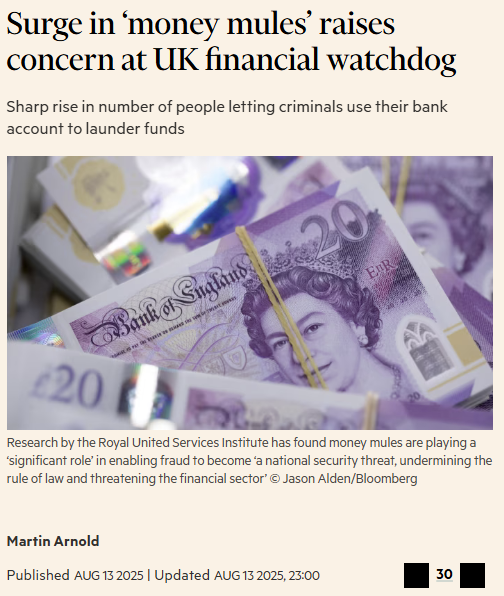
We have a category for "Money Mules" on the right. Given the prevalence of money mule cases in Ireland, thought this piece from the UK FCA might be of interest. Fintechs and digital banks are particularly exposed to the risk of money mules, the research found. RUSI said banking-as-a-service (BaaS) companies that provide payment or lending services to other fintechs were particularly exposed — receiving 10 per cent of payments it tracked from money mule accounts. Hard stats:
Andrea Bowe, a director at the FCA overseeing its work on fraud and financial crime, said the watchdog was working with financial firms, law enforcement and international counterparts. The regulator is also eager for tech companies to do more, given recruitment of mules often happens on social media, she said. “We recognise the scale of the challenge in tackling fraud generally, which is why fighting financial crime is one of the pillars of the new strategy announced this year by the FCA,” she said. Research released on Thursday by the Royal United Services Institute, a security think-tank, has found money mules are playing a “significant role” in enabling fraud to become “a national security threat, undermining the rule of law and threatening the financial sector”. The RUSI research, based on data from Lloyds Banking Group, urged financial services companies to share more real-time data to tackle the problem, particularly as more than half of funds received by money mules is paid out within an hour. Fintechs and digital banks are particularly exposed to the risk of money mules, the research found. RUSI said banking-as-a-service (BaaS) companies that provide payment or lending services to other fintechs were particularly exposed — receiving 10 per cent of payments it tracked from money mule accounts. “New entrants to the market, such as BaaS providers, also appear to be being exploited by fraudsters,” RUSI said. “This calls for a robust regulatory response.” The Lloyds data showed that 57 per cent of the funds flowing through money mule accounts exited via the UK’s Faster Payment system to other accounts and 20 per cent by value went to a single digital finance firm, which was unidentified. About 10 per cent of the funds were withdrawn from money mule accounts in cash via ATMs or branches, RUSI said, while nearly a fifth went on debit card payments, including some to international money transfer companies. A much smaller amount, less than 1 per cent, went to cryptocurrency exchanges. “While it has been known about for many years, there are signs that the number of money mules is growing,” said Kathryn Westmore, senior research fellow at RUSI. “It is generally like a game of whack-a-mole, where you tackle it in one area and it pops up in another.” However, despite rising concern about the issue, there has been a sharp fall in the number of money mules being reported to the UK national fraud database, which can result in the person being blocked from opening another bank account for six years.
Industry experts say the sharp drop in money mule reporting reflects calls by the authorities for financial firms to treat vulnerable customers better instead of any reduction in fraud or in the targeting of young people to launder funds. “The key driver here is very large regulated entities responding to changing guidance from a regulator — that is borne out in the significant drop in filings relating to younger people,” said Simon Miller, director of policy, strategy and communications at Cifas. The government said last year it would work with banks and local authorities to ensure “vulnerable or exploited people” were not removed from the banking system. The FCA this year urged firms to improve how they treat customers in vulnerable circumstances. Miller said the drop in filings could also partly reflect a change in Cifas reporting rules to avoid banks filing cases where they only suspect someone of being a money mule rather than having evidence they were complicit — but this was thought to have only had a marginal effect. He added that more money mules were being trained by their recruiters in what to tell banks when they are questioned, which may have contributed to the lower number of filings. More people are handing over their identities to allow fraudsters to open separate accounts in their name. Ben Donaldson, managing director for economic crime at trade body UK Finance, said many money mules were tricked or coerced into it without knowing it is a crime for which they could be imprisoned, even though few are convicted. “I don’t think we can say all mules are victims but certainly many mules are victims, so it’s a complicated problem,” he said. Source: https://www.ft.com/content/6f517e05-0561-442f-842f-72eba8d125f3
 Subscribe to our news service at HERE Thank you to our money laundering typology guest contributor who is a senior AFC professional working in Ireland on international financial crime matters. This person freely gives time to source interesting typologies and analyses them for our visitors. Contact us if you would like to do likewise, whether anonymous or credited. Man jailed for a year for recruiting money launderers 1. Summary
2. What’s interesting: i. For AML professionals, the case offers several critical lessons:
ii. This case demonstrates how recruitment, transaction monitoring, and international cooperation are focal points in preventing money laundering schemes Source: https://www.breakingnews.ie/ireland/man-jailed-for-a-year-for-recruiting-money-launderers-1690986.html
Funmi Abimbola jailed for three years
What Happened? Funmi Abimbola, a 26-year-old bank worker from Ireland, has been sent to prison for three years for aiding the Black Axe organised crime group in money laundering operations. Abimbola was in fact sentenced in the Circuit Criminal Court today to five years in prison with two suspended. Black Axe, known as a highly dangerous transnational organisation, is involved in various criminal activities, including fraud, trafficking, and violent crimes. Abimbola, who had a master's degree and a respectable position at the Bank of Ireland, was responsible for managing money mules and handling accounts for the group in Ireland. His criminal activities were uncovered during a broader investigation by the Garda National Economic Crime Bureau (GNECB) and Interpol into the Black Axe organisation. Abimbola's involvement became apparent after the investigation into a €1 million invoice redirection fraud from a solicitor’s office. Authorities found him using false identities, purchasing items with laundered money, and coordinating through encrypted messaging platforms with other members of the criminal group. Despite being initially released on bail, Abimbola fled to the UK but was later extradited back to Ireland, where he received a five-year sentence, two of which were suspended. Several other individuals associated with the money laundering scheme received suspended sentences. Of the €1m stolen from the solicitor’s office €700,000 of that money was recovered and ten people were convicted of laundering the money. Judge Pauline Codd said that he was "effectively oiling the wheels" of this crime. The judge also noted the irony of Abimbola having worked for Bank of Ireland during the commission of some of the offences. Gardaí and Interpol have been focused on the activities of the organised crime group known as Black Axe which originated in West Africa but has a global footprint. Black Axe has been involved in online fraud, human trafficking, drugs and gun crime as well as murder. Others convicted include:
Lessons for MLROs This case underscores critical areas of focus for Money Laundering Reporting Officers (MLROs):
Sources:
 What happened?What happened? A man has been arrested after being identified as a suspected money mule herder following the search of a residence in West Tallaght, Dublin. Gardaí from the Garda National Economic Crime Bureau (GNECB) carried out a search at the property as part of a larger investigation into incidents of fraud in Norway, Germany, the US, Hawaii and Ireland. The investigation also looked into the subsequent laundering of money through money mule accounts, businesses, and trade-based money laundering operations. "Up to 50 different money mules have been identified as having laundered over €196,000 through his bank accounts in Ireland, Germany and Belgium," a Garda spokesperson said. "This money came from victims of mainly smishing frauds in Ireland, was initially laundered through these 50 money mule accounts and then forwarded by the money mules to the suspects' three bank accounts." During the course of the search, a number of items, including a "high value" Range Rover, which was suspected to have been purchased with the proceeds of crime, were seized. The following items were also seized:
 Range Rover seized by Gardai What’s interesting?What’s interesting?
Source: https://www.irishexaminer.com/news/courtandcrime/arid-41205400.html Subscribe to our news service at HERE
Subscribe to our news service at HERE A 21-year-old Tralee man has pleaded guilty to four charges including money laundering relating to sums totalling over €50,000.
Tralee Circuit Criminal Court was told that the case of Fortunatus Ankomah of Rath Óraigh, Tralee, is the latest to arise from a major operation by gardaí. Fortunatus Ankomah pleaded guilty to three counts of converting, transferring, handling, acquiring, possessing, or using property which he knew, believed to be, or was reckless as to whether or not it was the proceeds of criminal conduct. This is an offence under the Criminal Justice (Money Laundering and Terrorist Financing) Act 2010. The first count related to a sum of €10,000, which was credited to an AIB account on 19th January 2021. The second count related to a sum of almost €22,000, which was credited to a separate AIB account on a date between 21st January and 26th January 2021. The third count related to a sum of almost €20,000, again credited to a third separate AIB account between March and June of 2021. Mr Ankomah also admitted to one charge relating to organised crime, whereby he enhanced the ability of a criminal organisation to commit money laundering, by participating in or contributing to an activity of that organisation. Subscribe to our news service at HERE The now 26-year-old woman was before Letterkenny Circuit Court on money laundering charges related to sums totalling €3,000 which she allowed to pass through her Revolut account.
A former ATU Donegal student who admitted being reckless in allowing her Revolut account to be used for money laundering has received a deferred sentence. Detective Garda Gerard McCready gave an outline of the case against Ms Balogun, who now lives and works in London. He told how a sum of €3,000 came into Ms Balogun's Revolut account from the bank account of another person on various dates in June, 2020. The money came in ten different instalments of €300. The funds later left Ms Balogun's account and the bank account it was transferred to was closed in August 2020. Subscribe to our news service at HERE Teenagers in secondary school, and some in third level, were paid thousands of euro to allow their bank accounts be used by a fraud gang recruiting in Co Kerry, only to be caught and convicted. While some of the younger offenders were dealt with under the Garda’s junior liaison scheme, others were convicted under anti-terrorism and money-laundering legislation.
The young people were working as so-called mules to facilitate money-laundering by a fraud gang, with controlling members based in Ireland and abroad. Each student allowed between €2,000 and €65,000 to pass through their accounts, for payments of between 10 and 15 per cent of the core sums. News of the scale of the operation in Kerry first emerged in The Irish Times two years ago when it was revealed about 50 young people had been recruited by one of their peers in the community. They surrendered their bank account details, and logins, so money from online frauds could be moved and laundered through the accounts. The Kerryman newspaper on Tuesday reported the total amount that passed through the accounts of the young suspects in Co Kerry reached €1.3 million. While that sum is not large on a national scale, it is a new departure for an organised crime network in the county. The bank accounts used were with mainstream banks and other institutions allowing for accounts to be opened online, including Revolut, N26 and TransferWise. Some of the mules, aged 16-20 years, allowed more than one of their accounts to be used. Det Sgt Ernie Henderson, from the Divisional Crime Team in Kerry, said the money that passed through the accounts had been stolen in scams involving bogus texts and emails – known as vishing and smishing – to unsuspecting people and companies. This tricked them into sending money to the accounts controlled by the gang. In other cases, the scammers extracted victims’ bank account details to steal their money, by transferring it into the young people’s accounts they controlled. Det Sgt Henderson confirmed some of the young people were prosecuted under the Money Laundering and Terrorist Financing Act 2010, with more than 30 Kerry-based mules already dealt with. He added this would disbar them from many opportunities, including securing visas for travel and work abroad and many other job opportunities. Det Sgt Henderson said some of the senior personnel, known as “herders”, in the gang were using Instagram, Snapchat, TikTok and other platforms “recruiting people to make easy money” by allowing their accounts to be used. “In this particular operation, it was a person that was known to [the young people in Kerry] and living in the community here,” he said of the man recruiting the students in the Tralee area. “That matter is still currently under investigation for him.” https://www.irishtimes.com/crime-law/2024/01/31/kerry-based-money-mules-laundered-13m-for-fraud-gang/ |
AuthorOn this page you will find a selection of links to articles useful for AFC training. Archives
September 2025
Categories
All
|



 RSS Feed