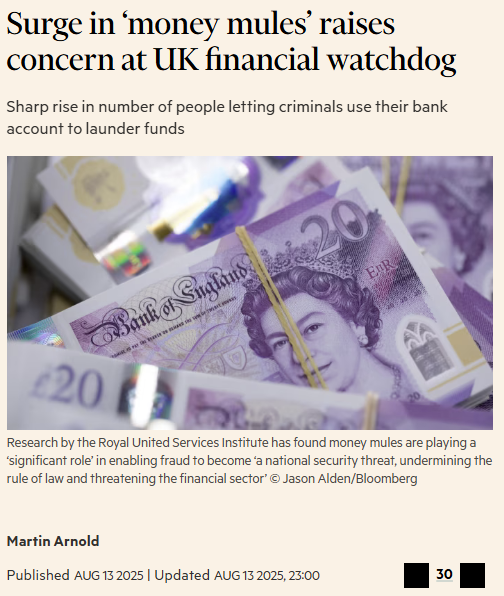
We have a category for "Money Mules" on the right. Given the prevalence of money mule cases in Ireland, thought this piece from the UK FCA might be of interest. Fintechs and digital banks are particularly exposed to the risk of money mules, the research found. RUSI said banking-as-a-service (BaaS) companies that provide payment or lending services to other fintechs were particularly exposed — receiving 10 per cent of payments it tracked from money mule accounts. Hard stats:
Andrea Bowe, a director at the FCA overseeing its work on fraud and financial crime, said the watchdog was working with financial firms, law enforcement and international counterparts. The regulator is also eager for tech companies to do more, given recruitment of mules often happens on social media, she said. “We recognise the scale of the challenge in tackling fraud generally, which is why fighting financial crime is one of the pillars of the new strategy announced this year by the FCA,” she said. Research released on Thursday by the Royal United Services Institute, a security think-tank, has found money mules are playing a “significant role” in enabling fraud to become “a national security threat, undermining the rule of law and threatening the financial sector”. The RUSI research, based on data from Lloyds Banking Group, urged financial services companies to share more real-time data to tackle the problem, particularly as more than half of funds received by money mules is paid out within an hour. Fintechs and digital banks are particularly exposed to the risk of money mules, the research found. RUSI said banking-as-a-service (BaaS) companies that provide payment or lending services to other fintechs were particularly exposed — receiving 10 per cent of payments it tracked from money mule accounts. “New entrants to the market, such as BaaS providers, also appear to be being exploited by fraudsters,” RUSI said. “This calls for a robust regulatory response.” The Lloyds data showed that 57 per cent of the funds flowing through money mule accounts exited via the UK’s Faster Payment system to other accounts and 20 per cent by value went to a single digital finance firm, which was unidentified. About 10 per cent of the funds were withdrawn from money mule accounts in cash via ATMs or branches, RUSI said, while nearly a fifth went on debit card payments, including some to international money transfer companies. A much smaller amount, less than 1 per cent, went to cryptocurrency exchanges. “While it has been known about for many years, there are signs that the number of money mules is growing,” said Kathryn Westmore, senior research fellow at RUSI. “It is generally like a game of whack-a-mole, where you tackle it in one area and it pops up in another.” However, despite rising concern about the issue, there has been a sharp fall in the number of money mules being reported to the UK national fraud database, which can result in the person being blocked from opening another bank account for six years.
Industry experts say the sharp drop in money mule reporting reflects calls by the authorities for financial firms to treat vulnerable customers better instead of any reduction in fraud or in the targeting of young people to launder funds. “The key driver here is very large regulated entities responding to changing guidance from a regulator — that is borne out in the significant drop in filings relating to younger people,” said Simon Miller, director of policy, strategy and communications at Cifas. The government said last year it would work with banks and local authorities to ensure “vulnerable or exploited people” were not removed from the banking system. The FCA this year urged firms to improve how they treat customers in vulnerable circumstances. Miller said the drop in filings could also partly reflect a change in Cifas reporting rules to avoid banks filing cases where they only suspect someone of being a money mule rather than having evidence they were complicit — but this was thought to have only had a marginal effect. He added that more money mules were being trained by their recruiters in what to tell banks when they are questioned, which may have contributed to the lower number of filings. More people are handing over their identities to allow fraudsters to open separate accounts in their name. Ben Donaldson, managing director for economic crime at trade body UK Finance, said many money mules were tricked or coerced into it without knowing it is a crime for which they could be imprisoned, even though few are convicted. “I don’t think we can say all mules are victims but certainly many mules are victims, so it’s a complicated problem,” he said. Source: https://www.ft.com/content/6f517e05-0561-442f-842f-72eba8d125f3
0 Comments
A very interesting case study / typology for fast growing digital banks, payments firms and crypto-asset services providers and indeed any fintech in any country where there are anti-money laundering requirements.
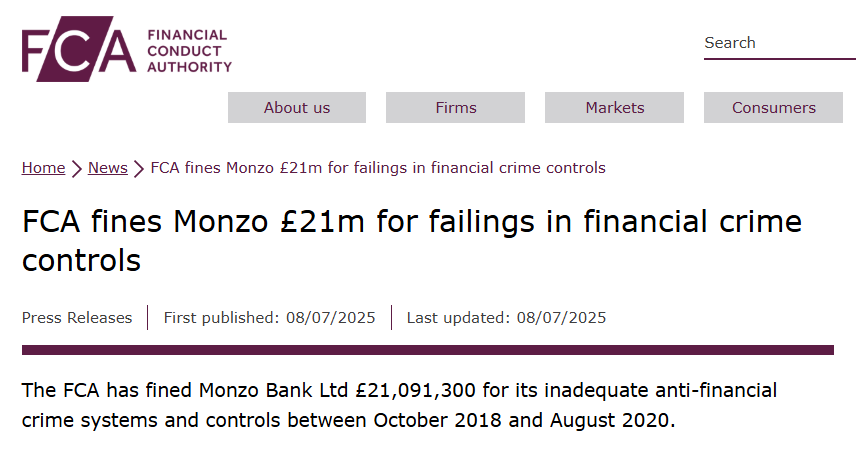
A few days ago our Peter Oakes wrote a piece on Linkedin about Monzo Bank's continuing plans to establish an authorised bank in Ireland. See https://www.linkedin.com/feed/update/urn:li:activity:7347556992883843072. Today the UK Financial Conduct Authority issued an enforcement notice and fine of £21mn against the rapidly growing digital bank. Hope this short blog helps financial crime professionals and MLROs with some useful thought for AFC training and the typology library. 📈 As Growth Accelerates, So Must Your Controls Rapid client onboarding and frequent product rollouts increase exposure to money laundering (ML) and terrorist financing (TF) risk. Firms often focus on scaling—the tech stack, user experience, marketing—while compliance lags. Regulatory expectations, however, demand that internal controls scale simultaneously. Digital banks must avoid the “too little, too late” trap. A detailed, documented risk assessment underpins everything: products, client segments, geographies, channels. That assessment must inform transaction monitoring rules, reporting thresholds, enhanced due diligence, ongoing review, staff training, management information (MI), and audit cycles. 🛡️ Foundation: AML/CTF Risk Assessment * Per Irish and EU standards, and echoed in Central Bank of Ireland guidance, your AML/CFT framework must include key elements: * Thorough risk assessment at the outset and with any material change (new product, geography, channel) * Board and senior management oversight with regular MI and challenge sessions * Tailored governance, controls, training, and testing based on risk This creates the durable infrastructure needed for AML resilience. 🧱 Case Study: Monzo’s £21M Fine for AML Failings In June 2025, the FCA levied a £21 million penalty on Monzo, citing systemic weaknesses in financial crime control frameworks as the firm scaled its product footprint. The FCA’s Final Notice (link below) highlighted:
👉 Access the case materials from FCA: “FCA fines Monzo £21 m for failings in financial crime controls”
This is a red flag for high-growth fintechs: internal control gaps are not just theoretical—they trigger high-profile enforcement. 🧭 Key Tactical Takeaways
✍️ Final Word for MLROs As MLROs at high-growth firms, your role is to translate risk into action. Ensure your AML/CFT framework is not just documented—but truly operational across all products and regions. Be proactive, visible, and predictive.  Thank you to our money laundering typology guest contributor who is a senior AFC professional working in Ireland on international financial crime matters. This person freely gives time to source interesting typologies and analyses them for our visitors. Contact us if you would like to do likewise, whether anonymous or credited. Metro Bank fined £16.6m for failings over money laundering checks 1. Summary
2. What’s interesting i. The Metro Bank case provides critical lessons for AML professionals, highlighting key areas of interest:
ii. This case highlights the critical need for robust systems, effective governance, and a culture of vigilance to maintain strong defences against money laundering risks. Source: https://www.ireland-live.ie/news/city/1653413/metro-bank-fined-16m-for-failings-over-money-laundering-checks.html
|
AuthorOn this page you will find a selection of links to articles useful for AFC training. Archives
September 2025
Categories
All
|
 RSS Feed