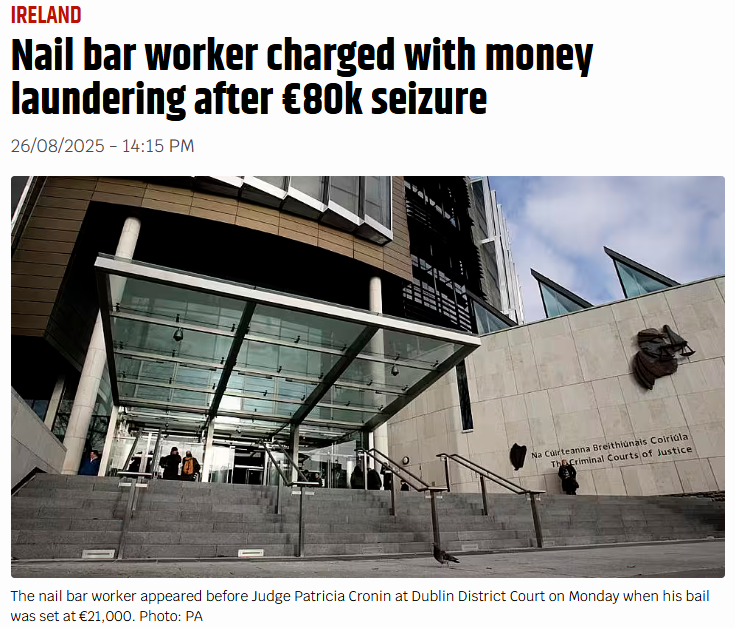
 Two Guest Contributors wrote a piece on this story. See the other one here. In late August 2025, a Dublin District Court case drew renewed attention to the use of cash-intensive businesses as potential vehicles for money laundering. Gardaí seized more than €78,000 and £10,800 from the home of a nail bar worker who claimed the funds were pooled from friends to open a new salon in Drogheda. While the accused insisted the cash was legitimate, the identities of these “friends” were never verified. Charged under section 7 of Ireland’s Criminal Justice (Money Laundering and Terrorist Financing) Act 2010, the case highlights the vulnerability of cash-based enterprises, such as nail bars, hairdressers, and takeaways, to exploitation by criminals seeking to disguise illicit proceeds.
Cash-intensive businesses (CIBs) are particularly attractive to launderers because their normal operations involve large volumes of physical currency, much of it untraceable. This environment creates opportunities to blend “dirty” money with legitimate earnings. A nail bar might take in hundreds of small cash payments daily, which makes it difficult for regulators or auditors to identify whether declared revenue figures accurately reflect real customer activity. By simply overstating takings, a business can introduce illicit cash into its books with little outward indication of wrongdoing. The laundering process often begins with placement: introducing the illegal funds into circulation. In the case of a CIB, this might mean recording criminal proceeds as part of the day’s takings. From there, layering can occur through deliberate manipulation of records or structured deposits designed to avoid triggering automatic reporting thresholds. In Ireland, banks are obliged to flag cash lodgements above €10,000, but launderers often “smurf” deposits, breaking down large sums into smaller amounts to slip under the radar. Once lodged, the money appears as legitimate business income, allowing it to be integrated into the financial system without immediate suspicion. This mechanism is not new, but it remains a persistent challenge for Irish authorities, particularly as criminal groups adapt quickly. The relatively low barriers to entry for businesses like nail bars or food outlets—combined with their dependence on cash—make them ideal for money launderers who seek plausible cover for unexplained wealth. Unless authorities can demonstrate a mismatch between declared turnover and actual activity, these businesses can provide a convincing front. Ireland’s anti-money laundering framework has attempted to respond to such risks. Under the 5th EU Anti-Money Laundering Directive, factors such as high reliance on cash or ownership by non-resident individuals are considered elevated risk indicators. Designated professionals, from accountants to property agents, are expected to carry out enhanced due diligence and file suspicious transaction reports where warranted. Yet the practical challenge remains: small-scale cash-based businesses operate at the margins of scrutiny, often falling below the thresholds that attract regulatory attention. The Dublin nail bar case underscores the importance of vigilance in this area. Cash-intensive businesses are part of everyday life and, in most instances, perfectly legitimate. However, their very nature provides the camouflage that money launderers need. For Ireland, strengthening oversight, improving the detection of red flags, and fostering a culture of questioning suspicious narratives will be essential if such businesses are to be prevented from becoming conduits for illicit finance. Source: https://www.breakingnews.ie/ireland/nail-bar-worker-charged-with-money-laundering-after-e80k-seizure-1795607.html
0 Comments
Your comment will be posted after it is approved.
Leave a Reply. |
AuthorOn this page you will find a selection of links to articles useful for AFC training. Archives
September 2025
Categories
All
|
 RSS Feed