MONEYLAUNDERING.IE
  • Home
  • Typologies
  • Regulatory Materials

Training Typologies

Money Laundering typologies, case studies and news 

Subscribe to our news service at HERE 

Metro Bank fined £16.6m for failings over money laundering checks

12/11/2024

0 Comments

 
Picture
​​Thank you to our money laundering typology guest contributor who is a senior AFC professional working in Ireland on international financial crime matters.  This person freely gives time to source interesting typologies and analyses them for our visitors. Contact us if you would like to do likewise, whether anonymous or credited.
Metro Bank fined £16.6m for failings over money laundering checks

1. Summary
  • i. Metro Bank was fined £16.6 million by the UK’s Financial Conduct Authority (FCA) for serious failings in its anti-money laundering (AML) systems and controls between June 2016 and December 2020. These deficiencies affected over 60 million transactions, collectively valued at more than £51 billion.
  • ii. The issues primarily arose from flaws in Metro Bank’s automated transaction monitoring system, introduced in 2016. Due to data input errors, the system failed to flag transactions on the same day accounts were opened and missed other high-risk activities until records were updated. Despite concerns raised by junior staff in 2017 and 2018, these problems persisted, with only partial fixes implemented in 2019 and full resolution achieved in late 2020.
  • iii. The FCA noted that the prolonged lapses in Metro Bank's controls created significant vulnerabilities in the UK's financial system, exposing it to criminal exploitation. Metro Bank has since updated its processes to address the deficiencies and strengthen its AML framework.

2. What’s interesting
i. The Metro Bank case provides critical lessons for AML professionals, highlighting key areas of interest:
  • Challenges with Automated Monitoring Systems: The failure of Metro Bank's transaction monitoring system due to input errors illustrates the risks of over-reliance on technology without robust validation and ongoing oversight. AML professionals must ensure data accuracy and conduct regular system audits to prevent similar issues.
  • Escalation and Governance Shortcomings: Despite junior staff raising concerns about the system's performance as early as 2017, meaningful action wasn't taken until years later. This underscores the importance of having strong escalation mechanisms and responsive governance structures to address identified weaknesses swiftly.
  • Regulatory Expectations for Proactive Risk Management: The FCA highlighted that prolonged lapses in addressing AML deficiencies significantly increase exposure to financial crime. AML professionals should note the regulator's emphasis on proactive risk identification and timely remediation as non-negotiable compliance standards.
  • Impact of Deficiencies on Financial System Integrity: Over £51 billion in transactions were inadequately monitored, exposing the system to exploitation by criminals. This reinforces the importance of comprehensive controls to safeguard the financial ecosystem, particularly for high-risk activities like account opening and large transactions.
  • Fines and Reputational Risk: The £16.6 million fine and public criticism demonstrate the severe consequences of AML failings, serving as a warning about the financial and reputational damage that can result from non-compliance.
​
ii. This case highlights the critical need for robust systems, effective governance, and a culture of vigilance to maintain strong defences against money laundering risks.

Source: ​ https://www.ireland-live.ie/news/city/1653413/metro-bank-fined-16m-for-failings-over-money-laundering-checks.html
0 Comments

Waystone fined by regulator over fund’s management of loan note investment

8/11/2024

0 Comments

 
Picture
Subscribe to our news service at HERE
​Thank you to our money laundering typology guest contributor who is a senior AFC professional working in Ireland on international financial crime matters.  This person freely gives time to source interesting typologies and analyses them for our visitors. Contact us if you would like to do likewise, whether anonymous or credited.
1. Summary
  • i.Waystone Fund Management (IE) Limited (WFM) was fined €393,512 by the Central Bank of Ireland for breaching EU AIFM regulations.
  • ii.Breaches included inadequate due diligence, poor conflict-of-interest management, weak delegate oversight, insufficient risk management, and unreliable valuation procedures.
  • iii.Between 2018 and 2019, €17.7 million was invested in illiquid private assets (loan notes) without adequate oversight, leading to a loss of €10.2 million for the fund’s investors.
  • iv.WFM later reached a settlement with investors, who recovered their initial investments.
  • v.The Central Bank imposed the fine and emphasized the importance of due diligence, effective governance, and robust valuation practices to protect investors.

2. What’s interesting
  • i. Due Diligence Failures: The case highlights the critical need for comprehensive due diligence processes when managing investments in high-risk, illiquid assets.
  • ii. Conflict of Interest Management: Effective identification and mitigation of conflicts of interest are central to maintaining investor trust and regulatory compliance.
  • iii. Regulatory Accountability: This case underscores how regulators enforce compliance through penalties and public reprimands to uphold financial system integrity.
  • iv. Valuation Accuracy: Proper valuation methods are essential to avoid exposing investors to unnecessary risks.
  • v. Oversight on Delegates: Strong oversight of third-party managers is vital to ensure adherence to regulatory standards and protect against mismanagement.
  • vi. For AML professionals, the case serves as a reminder to integrate stringent controls, risk assessments, and monitoring mechanisms into investment fund operations to avoid regulatory repercussions.
Source: https://m.independent.ie/business/waystone-fined-by-regulator-over-funds-management-of-loan-note-investment/a1485619477.html

0 Comments

Man jailed for a year for recruiting money launderers

4/11/2024

0 Comments

 
Picture
Subscribe to our news service at HERE
​Thank you to our money laundering typology guest contributor who is a senior AFC professional working in Ireland on international financial crime matters.  This person freely gives time to source interesting typologies and analyses them for our visitors. Contact us if you would like to do likewise, whether anonymous or credited. 
​Man jailed for a year for recruiting money launderers

1. Summary
  • i. A man in Louth was jailed for one year for recruiting individuals as money mules to facilitate money laundering activities, linking to organized crime.
  • ii. The individual coordinated with an international network, exploiting bank accounts to launder criminal proceeds. Victims were misled into fraudulent schemes, such as fake online sales.
  • iii. The judge highlighted the increasing sophistication of such crimes and imposed the sentence to serve as a deterrent. The individual's role was considered more severe than that of a typical money mule due to his active recruitment efforts.

2. What’s interesting:

i. For AML professionals, the case offers several critical lessons:
  1. Money Mule Recruitment: The individual actively recruited others to act as money mules, highlighting the need for financial institutions to monitor patterns indicative of mule account activities. Organized networks often exploit vulnerable individuals, increasing the complexity of detection.
  2. Organized Crime Links: The connection to international criminal organizations (e.g., "The Black Axe") underlines the importance of cross-border information sharing and collaboration in identifying and dismantling such networks. Enhanced due diligence and transaction monitoring are crucial in combating such schemes.
  3. Account Misuse and Fraud Typologies: Exploitation of personal bank accounts for laundering highlights gaps that institutions must address, such as better KYC measures and real-time anomaly detection. Monitoring for atypical transaction flows and the misuse of accounts by third parties is essential.
  4. Judicial and Enforcement Focus: The sentencing emphasized deterrence, showing regulatory and legal systems are taking an increasingly serious stance on participation in financial crimes, even for lower-tier actors like recruiters. This reinforces the importance of proactive reporting of suspicious activities.

ii. This case demonstrates how recruitment, transaction monitoring, and international cooperation are focal points in preventing money laundering schemes
Source: ​https://www.breakingnews.ie/ireland/man-jailed-for-a-year-for-recruiting-money-launderers-1690986.html

0 Comments

Gardai lodge €3.1 million in cash from proceeds of crime to the Exchequer

29/10/2024

0 Comments

 
Picture
  • Subscribe to our news service at HERE
  • Follow our Linkedin page HERE
  • Posted by Peter Oakes
​Thank you to our money laundering typology guest contributor who is a senior AFC professional working in Ireland on international financial crime matters.  This person freely gives time to source interesting typologies and analyses them for our visitors. Contact us if you would like to do likewise, whether anonymous or credited. ​
Gardai lodge €3.1 million in cash from proceeds of crime to the Exchequer

1. Summary
  • i. An Garda Síochána recently deposited over €3 million in cash, forfeited following criminal proceedings, into the Irish Exchequer. This is part of a broader effort, with more than €20 million recovered since the establishment of the Garda National Drugs and Organised Crime Bureau (GNDOCB) in 2015.
  • ii. The seized funds predominantly represent proceeds from drug trafficking, highlighting the financial underpinnings of serious and transnational organised crime groups. Gardaí emphasize that this money, often sourced from casual drug purchases, directly fuels criminality and perpetuates drug-related violence and intimidation.
  • iii. Gardaí linked drug money to widespread social harm, noting that casual drug users indirectly support criminal networks and exacerbate societal problems. They aim to dismantle these networks and enhance community safety through such financial interventions.

2. What’s Interesting
i. For AML professionals, several points from this article are particularly notable:
  • Seizure and Forfeiture as a Tool: The direct link between the seizure of funds and its impact on dismantling transnational organised crime groups underscores the critical role of financial intelligence and asset recovery in disrupting illicit networks. This case highlights how following the money can yield tangible results in combatting organised crime.
  • Connection Between Casual Drug Use and Organised Crime: The emphasis on how even small-scale drug purchases fund larger criminal enterprises is a stark reminder of the importance of educating stakeholders about the broader impact of seemingly minor transactions. For AML efforts, it reinforces the need to monitor and address seemingly low-risk behaviors that contribute to high-risk activities.
  • Public-Private Collaboration Potential: The successful recovery of over €20 million since 2015 illustrates the potential for enhanced cooperation between law enforcement and financial institutions. For AML professionals, it’s a reminder to refine systems that detect and report suspicious activities linked to drug trafficking, ensuring stronger alignment with law enforcement efforts.
  • Proceeds of Crime Narrative: The article ties the proceeds of crime to real-world impacts, such as community safety and societal harm. For AML professionals, this reinforces the need to focus not just on regulatory compliance but also on the ethical and societal imperatives of combating financial crime.

ii. These takeaways provide valuable context for designing and enhancing AML frameworks to target not only high-value transactions but also patterns and behaviors indicative of broader criminal networks.
Source: ​https://www.dublinlive.ie/news/gardai-lodge-31-million-cash-30256934
0 Comments

20241024 - 26y.o former Bank of Ireland Employee jailed for 3 years.  Several others convicted of laundering

24/10/2024

0 Comments

 
Funmi Abimbola jailed for three years
  • Subscribe to our news service at HERE
  • Follow our Linkedin page HERE
  • Posted by Peter Oakes
What Happened?
​

Funmi Abimbola, a 26-year-old bank worker from Ireland, has been sent to prison for three years for aiding the Black Axe organised crime group in money laundering operations. Abimbola was in fact sentenced in the Circuit Criminal Court today to five years in prison with two suspended. 

​
Black Axe, known as a highly dangerous transnational organisation, is involved in various criminal activities, including fraud, trafficking, and violent crimes. Abimbola, who had a master's degree and a respectable position at the Bank of Ireland, was responsible for managing money mules and handling accounts for the group in Ireland. His criminal activities were uncovered during a broader investigation by the Garda National Economic Crime Bureau (GNECB) and Interpol into the Black Axe organisation.
​
Abimbola's involvement became apparent after the investigation into a €1 million invoice redirection fraud from a solicitor’s office. Authorities found him using false identities, purchasing items with laundered money, and coordinating through encrypted messaging platforms with other members of the criminal group. Despite being initially released on bail, Abimbola fled to the UK but was later extradited back to Ireland, where he received a five-year sentence, two of which were suspended. Several other individuals associated with the money laundering scheme received suspended sentences.

Of the €1m stolen from the solicitor’s office €700,000 of that money was recovered and ten people were convicted of laundering the money.
Judge Pauline Codd said that he was "effectively oiling the wheels" of this crime.  The judge also noted the irony of Abimbola having worked for Bank of Ireland during the commission of some of the offences. 
Gardaí and Interpol have been focused on the activities of the organised crime group known as Black Axe which originated in West Africa but has a global footprint. Black Axe has been  involved in online fraud, human trafficking, drugs and gun crime as well as murder.
Others convicted include:
  • Cameron Fanning 25 - pleaded guilty to two counts of money laundering from the solicitor's firm on 9 November 2020 and one count of giving false information about his bank account to gardaí. Sentenced to three and half years in prison, suspended in full on strict conditions.
  • Mubarak Salawu, 22 - pleaded guilty to one count of money laundering in relation to the stolen monies which were credited to his account and an unrelated charge of possessing a pair of €600 Balenciaga runners bought from the proceeds of crime. Suspended two-year prison sentence.
  • Olumide Lawal, 27 - admitted two counts of money laundering and possession of a €900 iPhone bought using the proceeds of crime. Given a suspended two-year sentence.
  • Aaron Clancy, 21 - pleaded guilty to possessing €3,020, the proceeds of money laundering, in relation to the solicitor's firm and a further unrelated count of possessing €4,650, the proceeds of crime.  Received a suspended prison sentence of two years.
Lessons for MLROs

This case underscores critical areas of focus for Money Laundering Reporting Officers (MLROs):
  1. Enhanced Employee Monitoring: Abimbola’s role as a bank employee gave him the knowledge to exploit bank systems. MLROs should implement robust internal controls and monitor employees in sensitive roles to detect unusual behavior patterns.
  2. Fraud Detection: The invoice redirection fraud highlights the need for vigilant detection systems around financial transactions, particularly large sums and high-risk entities.
  3. Cross-Border Collaboration: The transnational nature of Black Axe’s operations exemplifies the importance of cross-border cooperation in identifying and curtailing complex money laundering schemes.
  4. Rapid Response to Suspicious Activity: Abimbola’s case illustrates that quick responses to internal and external red flags—such as abnormal bank transactions, unusual cash handling, or interactions with known criminals—can prevent escalation and assist in ongoing investigations.
  5. Adaptation to Evolving Criminal Methods: Criminal tactics constantly shift, as shown by Black Axe’s pre-pandemic strategies compared to their current operations. Continuous learning and adaptation are essential for MLROs to stay ahead of evolving threats.
Sources:
  • https://www.rte.ie/news/courts/2024/1023/1477127-funmi-abimbola-crime-gang-jailed/
  • https://www.breakingnews.ie/ireland/bank-worker-jailed-for-money-laundering-and-assisting-organised-crime-1686765.html
  • https://www.irishtimes.com/crime-law/courts/2024/10/24/bank-worker-jailed-for-laundering-money-for-black-axe-international-crime-gang/ (limited free access)

​
0 Comments

20241013 - Ex-garda warns proposed gambling laws will be hard to police

13/10/2024

0 Comments

 
Picture
  • Subscribe to our news service at HERE
  • Follow our Linkedin page HERE
  • Posted by Peter Oakes
A former senior garda has warned proposed new gambling laws restricting stakes and winnings will increase black market betting and lead to resource challenges for the force.

Pat Lordan, a former chief superintendent at the Garda National Economic Crime Bureau, said the Government’s new Gambling Regulation Bill poses increased money laundering risks.

He said “over regulating” the gambling industry will encourage criminal networks to facilitate underground markets which are difficult to police.

“It is resource intensive if you have to go to every casino in the country that is legal and not legal, because they are not going to have a sign over the door,” he added.

“It will fall back to Johnny the guard down in Dingle to go out on his pushbike and see if there is any gambling there in the shed of a house.”
​

Source: 
​https://www.independent.ie/irish-news/ex-garda-warns-proposed-gambling-laws-will-be-hard-to-police/a1806305629.html

0 Comments

20241010 - Bitcoin seized by Cab soars in value to more than €350m

10/10/2024

0 Comments

 
Picture
  • Subscribe to our news service at HERE
  • Follow our Linkedin page HERE
  • Posted by Peter Oakes
1.  What Happened?
 It seems that the Criminal Assets Bureau (CAB) is facing a significant challenge in accessing €345 million in Bitcoin seized from Crumlin drug dealer Clifton Collins. The Bitcoin, originally valued at €53 million when seized in 2019, is locked away in 12 digital wallets, with the keys to access them reportedly missing.  Collins created 12 wallets for storing the bitcoin and recorded the codes, or digital keys, for each in a document. Collins decided it would be safer to disperse his growing fortune across multiple virtual wallets that hold the cryptocurrency. 

The Bitcoin was uncovered by the Garda after an operation targeting Collins (in 2019) when it was valued at €53 million. Garda has effectively been sitting on the asset, hoping advances in technology will lead to it being unlocked, it has soared in value to €345 million.

Collins – a 53-year-old former beekeeper – grew cannabis crops in rented houses and sold the harvested drug to criminals, including in his native Crumlin. He was apprehended in 2017 after a cannabis growing operation was discovered by chance  after years of operating under the radar. Gardaí on a routine patrol spotted a car parked at Military Road near Sally Gap in Co Wicklow in the early hours of the morning and went to check on it. Cannabis herb valued at €2,000 was found in the car, driven by Collins.

A subsequent investigation discovered he had been using three rented houses – in Galway, Meath and Longford – to grow cannabis. In the property in Galway, gardaí discovered a crop valued at €400,000 and Collins was later jailed for five years.

Eventually the Irish 
High Court ruled that the Bitcoin was derived from criminal activity. While Collins had handed over some Bitcoin and a code to a portion of his stash, the bulk remains inaccessible due to the lost key, which was hidden in a fishing rod that has since gone missing.  

Collins invested some of the proceeds of his drugs business in bitcoin, when it was worth only a fraction of its current value, in 2011 and 2012. As the virtual currency increased in value, Collins decided it would be safer to disperse his growing fortune across multiple virtual wallets that hold the cryptocurrency. The keys for the 12 wallets were written on documents and then hidden in a fishing rod case at one of his rented properties, in Co Galway. In interviews with gardaí he claimed he never saw the case again after a break-in at his home. However, a clear-out of the property after his arrest may also have resulted in the loss of the document.

In late 2020, Collins surrendered assets worth €1.2 million to the State as they were the proceeds of crime. They included €1 million in bitcoin, which he had the key codes for, as well as a two-seater Gyro aircraft, a camper van and a fishing boat.

Despite the value of the Bitcoin skyrocketing, CAB is hopeful that advances in technology will eventually allow them to unlock the wallets. In the meantime, they have liquidated other assets and sold accessible Bitcoin to benefit the state. Collins remains a significant case for the CAB, marking him as their largest financial loss to date. The outcome of this situation will depend on future technological developments or the recovery of the missing key.

Pursuing Bitcoin as the Proceeds of Crime is not new

The Chief Bureau Officer of CAB informed Irish media way back in October 2021 that CAB is targeting the seizure of cryptocurrencies, however, the value of cryptoassets can be difficult to realise.  Back then Detective Chief Superintendent Michael Gubbins said cryptocurrency plays a part in some of the assets that CAB has seized and while there is a substantial value to the cryptocurrency, "we just don't have the keys to get that".

2.  What’s interesting?
  • For AML professionals, cryptocurrency is becoming a regulated 'asset class' under MiCAR, just like 'financial instruments' are under MiFID.  This means is will be more and more common for regulated firms to be doing business with crypto firms.  Firstly,  banning 'crypto' outright in a world where it is regulated will no longer an option. Secondly, care will need to be taken as part of the CDD to ensure that the source of the crypto is legitimate and that the counterparty/introducer is regulated in a trustworthy jurisdiction.
  • It highlights the fact that despite access to high levels of resources and technology, law enforcement are not necessarily unable to break cryptography security measures of cold wallets.
Source:
  • https://www.sundayworld.com/crime/irish-crime/cab-still-unable-to-access-350-million-in-bitcoin-seized-from-crumlin-dealer/a128832277.html
  • ​https://www.irishtimes.com/crime-law/2024/10/09/bitcoin-seized-by-cab-soars-in-value-to-more-than-350m/
  • https://www.rte.ie/news/business/2021/1015/1253984-value-of-seized-cryptocurrencies-difficult-to-realise/
0 Comments

20241004 - Man accused of having €335k in crime proceeds after 'romance fraud' investigation

4/10/2024

0 Comments

 
Picture
  • Subscribe to our news service at HERE
  • Follow our Linkedin page HERE
  • Posted by Guest Contributor 
1.  Summary
  • A suspect was charged in connection with possessing €335,000 in alleged crime proceeds after a Garda investigation into a "romance fraud" scheme.
  • The investigation by the Garda National Economic Crime Bureau (GNECB) revealed that the funds were suspected to be proceeds of crime obtained from victims through romance scams.
  • The offenses allegedly took place between February 2017 and February 2020, with additional charges linked to transactions in 2021.
  • The suspect has been prohibited from using dating websites as part of bail conditions and will face trial at a later date.
  • The case involves international victims, including a person from Finland.

2.  What’s interesting
  • For AML professionals, this case is notable due to its connection to a "romance fraud" typology, where significant crime proceeds were funneled through personal relationships.
  • It highlights the importance of monitoring unusual financial transactions linked to personal accounts, as romance scams often involve victims unknowingly laundering funds. 
Source:
  • https://www.breakingnews.ie/ireland/cocaine-worth-e6m-seized-as-garda-investigation-targets-major-irish-crime-cartel-1672903.html
  • https://www.rte.ie/news/crime/2024/0917/1470476-drug-seizsure/
0 Comments

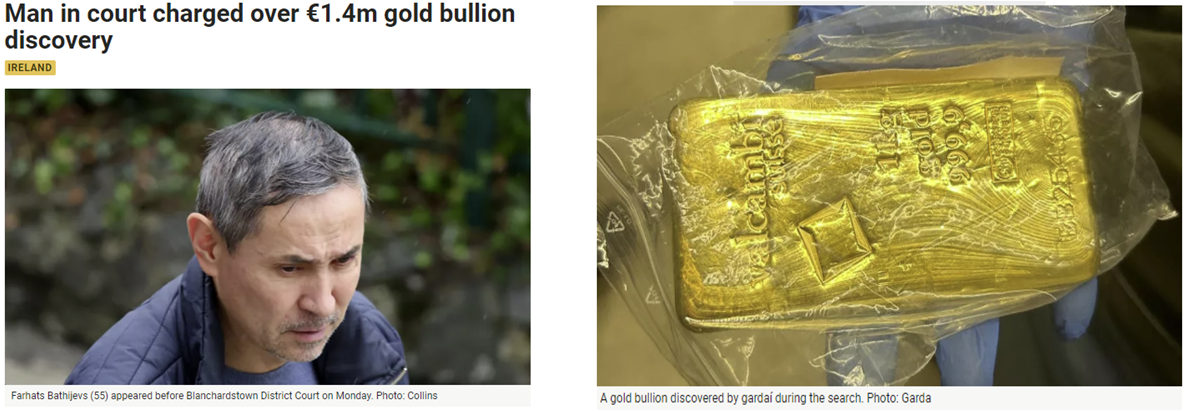
20240930 - Man in court charged over €1.4m gold bullion discovery

30/9/2024

0 Comments

 
Picture
  • Subscribe to our news service at HERE
  • Follow our Linkedin page HERE
  • Posted by Guest Contributor ​
Summary
  • A suspect appeared in Blanchardstown District Court charged with offenses related to the discovery of €1.4 million worth of gold bullion in Dublin.
  • The Gardaí seized €460,000 in cash and €210,000 in suspected cocaine and ecstasy during the operation.
  • The suspect faces multiple charges, including money laundering, theft, fraud involving false documents, possession of drugs, and supply of drugs.
  • Two women were also arrested in connection with the case and can be held for up to seven days for questioning.
  • The suspect has been remanded in custody and will appear via video link from Cloverhill prison.

What’s interesting
  • For AML professionals, this case is notable due to the significant amount of cash and drugs involved, which suggest potential money laundering activities.
  • The operation's complexity—linking gold bullion, cash, and narcotics—highlights the need for robust compliance measures to detect and prevent financial crime.
  • Additionally, the involvement of false documents emphasizes the importance of thorough due diligence and monitoring of transactions to combat fraud and illicit activities within financial systems.

Source:
  • https://www.breakingnews.ie/ireland/man-in-court-charged-over-1-4-million-euro-gold-bullion-discovery-1677860.html
  • https://www.bbc.com/news/articles/c3e9zkpd0nxo
0 Comments

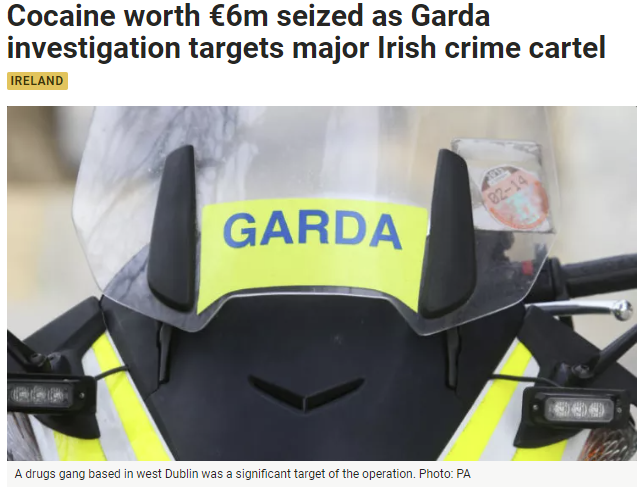
20240917 - Cocaine worth €6m seized as Garda investigation targets major Irish crime cartel

17/9/2024

0 Comments

 
Picture
  • Subscribe to our news service at HERE
  • Follow our Linkedin page HERE
  • Posted by Guest Contributor 
1.  Summary
  • Gardaí seized approximately €6 million worth of cocaine in an international crackdown targeting a major Irish crime cartel.
  • The operation, involving Europol, the FBI, and other international agencies, targeted a drugs gang based in west Dublin and other criminal figures.
  • The investigation disrupted an encrypted communication platform used for drug trafficking, homicides, and money laundering.
  • Raids were conducted in Co Wexford and Dublin, leading to several arrests.
  • The cartel, though smaller than the Kinahan group, has been a Garda target for decades due to its significant criminal operations.

2.  What’s interesting
  • For AML professionals, the most notable aspect of this case is the collaboration between multiple international law enforcement agencies, including Europol and the FBI, to dismantle a communication network used for drug trafficking, homicides, and money laundering.
  • It underscores the need for organizations to monitor the use of encrypted platforms and conduct robust due diligence on communication methods that could be exploited by criminal enterprises.
  • Additionally, it highlights the value of cross-border cooperation in combatting sophisticated crime cartels with a long history of illicit activity.
0 Comments
<<Previous
Forward>>

    Author

    On this page you will find a selection of links to articles useful for AFC training.

    Archives

    September 2025
    August 2025
    July 2025
    June 2025
    May 2025
    January 2025
    December 2024
    November 2024
    October 2024
    September 2024
    August 2024
    July 2024
    April 2024
    March 2024
    February 2024
    January 2024
    November 2023
    July 2023
    June 2023
    May 2023
    April 2023
    March 2023
    September 2022
    July 2021
    February 2021
    May 2017
    April 2017
    November 2016
    June 2012

    Categories

    All
    AIB
    Bank Of Ireland
    Bitcoin
    CAB
    Cash Intensive Businesses
    Catriona Carey
    Central Bank Of Ireland
    Crypto
    Danske Bank
    DNB
    Drug Trafficking
    Employee Theft
    Enforcement
    European Banking Authority
    EuroPol
    Fake Identities
    FBI
    Financial Conduct Authority
    Gambling
    Garda
    Gold Bullion
    Guest Contributor
    INTERPOL
    Money Mules
    NCA
    Payments
    PEPs
    Permanent TSB
    Professional Enablers
    Professionals
    Regulatory Fines
    Revolut
    Romance Fraud
    RTE
    Sandbox
    SARs
    Statistics
    Student Money Mules
    Trade Based Money Laundering
    UBS
    Ulster Bank
    Waterford Football Club

    RSS Feed

Site powered by Weebly. Managed by Bluehost
  • Home
  • Typologies
  • Regulatory Materials