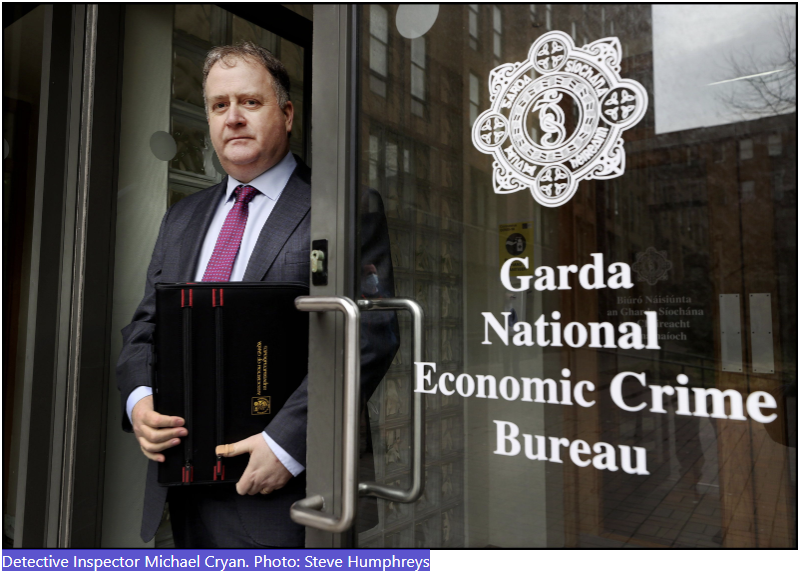
Det Insp Cryan said this case highlights the role of professionals who help oil the wheels of criminality, known in the policing world as “professional enablers”. The Garda National Economic Crime Bureau (GNECB) is running several probes into suspected property frauds, Detective Inspector Michael Cryan told the Sunday Independent. This type of fraud came to prominence in June when a solicitor and a former millionaire were jailed for using fake deeds to register new owners of two Dublin houses. Det Insp Cryan said lawyers, accountants, investment advisers and company formation advisers, who are complicit through negligence or dishonesty, are increasingly being targeted in crime investigations. “The GNECB continues to target the professionals and professional enablers who commit so called white-collar crime for their own benefit or the benefit of others,” he said. “These can be solicitors, accountants and/or trusted local businesspeople. This is important as their actions erode public trust in the legal and business world. Property re-registration fraud can only work with the involvement of solicitors who use their trusted legal positions to help commit these frauds. “We have other investigations ongoing into property fraud as well,” added Det Insp Cryan, who said this type of fraud is a “relatively new” one, first surfacing in the last decade. 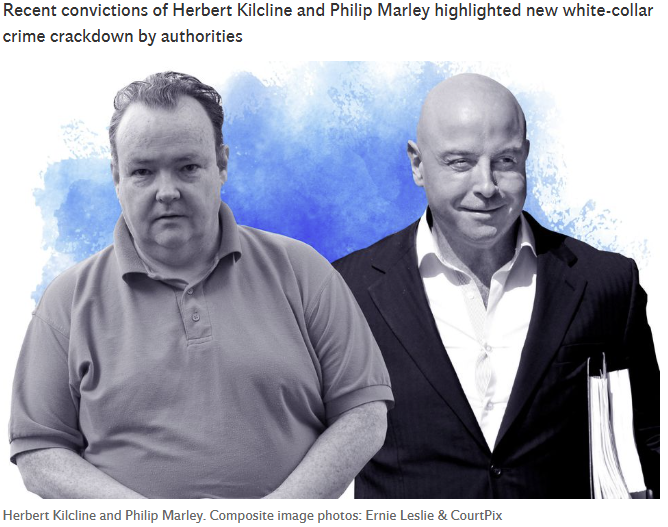 In June, Herbert Kilcline (63), a former solicitor, of Bessborough Parade, Rathmines, Dublin, and Philip Marley (53), of Ashtown, Dublin, were convicted in connection with using false deeds to change the registered ownership of the properties without the owners’ knowledge. Det Insp Cryan said this case highlights the role of professionals who help oil the wheels of criminality, known in the policing world as “professional enablers”. “A solicitor’s signature carries a lot of weight,” he said. One of those properties, Dublin Circuit Criminal Court heard, was rented in Phibsborough, with a lease income of €245,000 transferred to the US by Marley and never recovered. The other was a boarded-up Victorian house on St Mary’s Road in Dublin that had been repossessed by a financial institution. The fraud came to light when the St Mary’s Road property appeared on the Property Price Register in 2018 as sold to a company for €525,000, and the sale was challenged. The house has since been sold legitimately for €1.6m. Marley, helped by Kilcline, used false deeds to register two companies as the owners of the two properties. Kilcline, who is no longer a practising solicitor, was jailed for two-and-a-half years, and Marley was jailed for three years. While Marley was identified by the sentencing judge as the “orchestrator” of the fraud, Kilcline played a key role. Without Kilcline’s professional lawyer’s signature passing off fake conveyancing deeds as genuine, the scheme would not have worked, according to Det Insp Cryan. “That property registration fraud would not have worked without a solicitor’s involvement in it,” he said. Kilcline is not the only professional who has crossed the line between advising clients and actively helping them to break the law for criminal gain, but he is one of the few to be prosecuted for doing so. Cases that have been investigated by the GNECB include a solicitor who was probed for his continued representation of various members of a family notorious for making bogus insurance claims. He has not been prosecuted. And most solicitors who have received prison sentences in recent years were found to have stolen from client funds or from institutions, for personal gain. Michael Lynn (57) was jailed last year for five-and-a-half years for a €27m mortgage fraud which he used to fund his property investments. Fellow former solicitor Thomas Byrne (59) was convicted in 2013 of stealing €52m from six banks and defrauding 13 clients of their houses or money. Kilcline was in a different category as a classic “professional enabler” who rubbed shoulders with criminals, personally and professionally. The solicitor first came to Det Insp Cryan’s attention when he was leading the investigation into the murder of teenager Marioara Rostas. Just 18 years old, Ms Rostas was begging with her brother on Lombard Street in Dublin city centre when she went missing. Her body was later found in the Dublin mountains. Gangland criminal Alan Wilson was a suspect. Kilcline knew Wilson’s associates and was one of several people arrested in connection with possessing or withholding information. Kilcline later claimed to the Sunday World that he convinced one of Wilson’s associates to testify against him, and bring gardaí to the site where Marioara was buried. Despite Fergus O’Hanlon’s testimony, Wilson was acquitted by a jury in 2014. Kilcline later claimed that, as a result, his life was in danger from Wilson. Marley was among Kilcline’s more respectable clients. From north Dublin, he was flamboyant and, at one time, a wealthy businessman. He ran a male striptease act called Celtic Knights in the 1990s, before making €10m aged 33 from his student accommodation business, Ely Property Group. He was romantically involved with reality TV star Dana Wilkey, of The Real Housewives of Beverly Hills. His property group was liquidated in 2013, and he went bankrupt, owing €6.6m, in 2019. In the intervening years, Marley teamed up with Kilcline. Marley was promoting a US company that planned on taking over abandoned and derelict properties in Ireland, doing them up, and asserting squatters’ rights to claim ownership after 12 years. Kilcline was his legal adviser. Marley and Kilcline went from that to property registration fraud, which they engaged in between 2016 and 2018. At one point, Marley wrote to the Property Registration Authority, under a false name, pretending to be an employee of Kilcline. Sentencing Marley, the judge called him the “author” of the scheme that was motivated by personal gain. Professionals had been “duped” and ended up being investigated as a result of his actions, Judge Sinéad Ní Chúlacháin said. But she rejected Kilcline’s argument that he was guilty of “professional negligence” rather than criminality. It seemed Kilcline’s troubles came all at once. As he was being probed for the property fraud, he was convicted of social welfare fraud, falsely claiming disability and other payments worth €127,000. He was sentenced to 21 months in jail. Kilcline, who was impacted by thalidomide – the morning-sickness drug that caused birth defects in thousands of babies born worldwide in the 1950s and 1960s – blamed the fraud on his difficulty in accessing compensation. Kilcline’s lawyers told the court that he had been a “covert human intelligence source” for gardaí, his life had been threatened, and gardaí uncovered “two separate conspiracies to murder him”. A spokesperson for Tailte Éireann, a state agency responsible for property registrations, said it cannot comment on any active investigation. “We actively assist An Garda Síochána with any requests received. Tailte Éireann has a dedicated counter-fraud unit that seeks ways to combat property fraud,” the statement said. “One such initiative is Property Alert. This is a free service that provides an early notification, by email and/or text message, of certain activity on a property that you are monitoring. This allows you to take prompt action if you believe the activity is unexpected.” Source: https://www.independent.ie/irish-news/crime/gardai-home-in-on-lawyers-and-accountants-involved-in-suspected-property-fraud/a505807651.html
0 Comments
Leave a Reply. |
AuthorOn this page you will find a selection of links to articles useful for AFC training. Archives
September 2025
Categories
All
|
 RSS Feed