MONEYLAUNDERING.IE
  • Home
  • Typologies
  • Regulatory Materials

Training Typologies

Money Laundering typologies, case studies and news 

Subscribe to our news service at HERE 

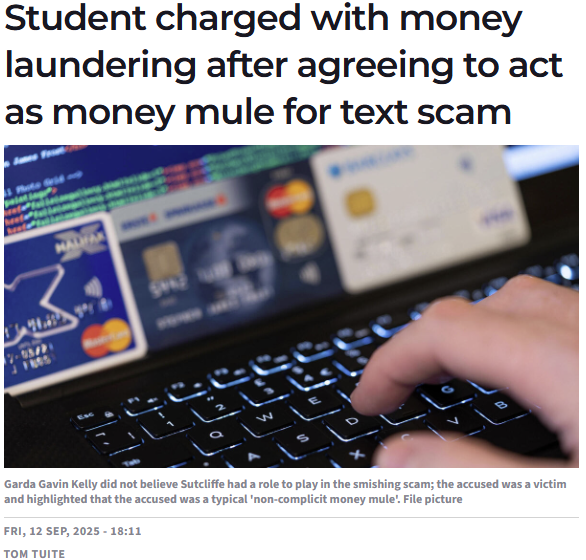
Student charged with money laundering after agreeing to act as money mule for text scam

12/9/2025

0 Comments

 
Picture
  • Subscribe to our news service at HERE
  • Follow our Linkedin page HERE
  • Posted by Guest Contributor 
​Student charged with money laundering after agreeing to act as money mule for text scam [September 12, 2025]

Summary:
i.  A 20-year-old student, Darragh Sutcliffe, pleaded guilty to money laundering after agreeing to act as a money mule for a “smishing” (text phishing) scam. He had no prior convictions. At the time of the offence, he was planning to sit accountancy exams.

ii. Between 23-25 May 2023, €16,350 in fraudulently obtained funds from smishing scams were deposited into his account in four separate transactions. €9,350 came from one victim (Cork woman) via an “E-flow text scam” after she responded to a malicious message. Another €2,000 from a Killarney resident.

iii.  Sutcliffe withdrew about €3,500 from ATMs in Lucan before his bank froze his account. After his account was flagged, he went to Gardaí and made a false report to try to distance himself from the transactions. The banks reimbursed the victims, except AIB remained out €3,500 (the ATM withdrawals).

iv.  In court, his solicitor emphasised that he was a typical “non-complicit money mule” — i.e. someone who allows just their account to be used on promise of payments which never materialised.
v.  He’ll repay the stolen funds, was contrite, has family support; sentencing has been adjourned until February. The judge also ordered a €5,000 donation to a cancer charity.

2. What’s interesting:

i.  Money mule risk & identification
  1. This case illustrates the pattern of how innocent or at-least non-fully aware persons are recruited as money mules: promised a small payment, asked to allow their bank account to be used, but then funds are moved through them.
  2. Useful reminder that “non-complicit” classification is possible: people may not know the full scope. That has implications for how to treat suspicious activity, assessing intent, and for reporting obligations.

ii.  “Smishing” / phishing via text + social media (Snapchat in this case)
  1. Attack vectors continue to evolve. A compliance program must factor in threats arising from text messages (“E-flow text scam”) and social media solicitations, not just email or more established channels.
  2. Awareness programs are essential: many victims are falling for such scams, and many “mules” believe they will be paid or are told they are doing something innocuous.
​
iii.  Bank account usage, transaction monitoring, freezing mechanisms
  1. The bank froze the account once suspicious, but a portion had already been withdrawn via ATM. That shows time lag can allow losses.
  2. Compliance officers should emphasize timely detection and account freezing protocols, perhaps thresholds or red flags designed to catch multiple deposits from unknown sources in quick succession.

iv.   False reports / attempts to distance oneself
  1. After being alerted to suspicious transactions, the accused made a false statement to law enforcement. That underscores potential challenges in investigations, where innocent or semi-innocent parties may try to shift blame or deny involvement.
  2. Compliance teams and audit/investigative functions should anticipate this and ensure proper records (bank statements, communications) are preserved.

v.  Financial harm & liability:
  1. The banks reimbursed most victims, but one bank incurred loss via ATM withdrawals. That illustrates exposure risk to financial institutions even when victims’ losses are covered; also reputational risk.
  2. From a compliance standpoint, institutions need strong policies on reimbursement, reporting to regulators, all tied into AML / fraud prevention frameworks.

vi.  Education & awareness as mitigation
  1. The accused plans to speak to local schools about dangers of such scams. The court noted that awareness 2 years ago was lower.
  2. Suggests a role for financial institutions, regulators, and compliance functions in public education and outreach to reduce the supply of money mules.

vii.  Sentencing & regulatory implications
  1. The punishment isn’t yet final, but there is recognition by the court of mitigating factors (lack of prior conviction, remorse, family support).
  2. For compliance programs, knowing how courts treat “non-complicit” mules is important for internal policies (e.g. deciding when to refer for prosecution vs when to consider them victims/responsive parties).


Source: https://www.irishexaminer.com/news/arid-41704397.html
0 Comments

Your comment will be posted after it is approved.


Leave a Reply.

    Author

    On this page you will find a selection of links to articles useful for AFC training.

    Archives

    September 2025
    August 2025
    July 2025
    June 2025
    May 2025
    January 2025
    December 2024
    November 2024
    October 2024
    September 2024
    August 2024
    July 2024
    April 2024
    March 2024
    February 2024
    January 2024
    November 2023
    July 2023
    June 2023
    May 2023
    April 2023
    March 2023
    September 2022
    July 2021
    February 2021
    May 2017
    April 2017
    November 2016
    June 2012

    Categories

    All
    AIB
    Bank Of Ireland
    Bitcoin
    CAB
    Cash Intensive Businesses
    Catriona Carey
    Central Bank Of Ireland
    Crypto
    Danske Bank
    DNB
    Drug Trafficking
    Employee Theft
    Enforcement
    European Banking Authority
    EuroPol
    Fake Identities
    FBI
    Financial Conduct Authority
    Gambling
    Garda
    Gold Bullion
    Guest Contributor
    INTERPOL
    Money Mules
    NCA
    Payments
    PEPs
    Permanent TSB
    Professional Enablers
    Professionals
    Regulatory Fines
    Revolut
    Romance Fraud
    RTE
    Sandbox
    SARs
    Statistics
    Student Money Mules
    Trade Based Money Laundering
    UBS
    Ulster Bank
    Waterford Football Club

    RSS Feed

Site powered by Weebly. Managed by Bluehost
  • Home
  • Typologies
  • Regulatory Materials