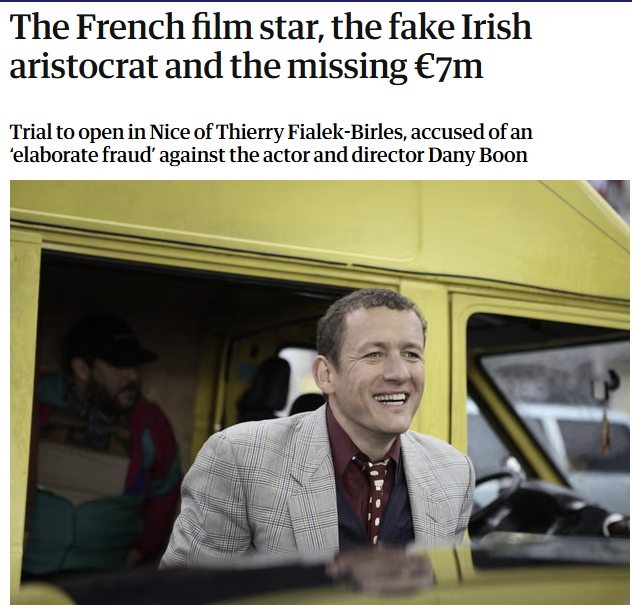
 The saga of Thierry Fialek‑Birles—known in some circles as “Terry Birles,” the self‑styled Irish aristocrat—reveals the elaborate mechanics by which confidence fraud and money laundering intertwine, particularly in cross‑border contexts. His multi‑million‑euro scheme, which ensnared celebrated French comedian and filmmaker Dany Boon, was woven with layers of deception that offer vivid insight into typologies of transnational financial crime.
Claiming decency, heritage, and legal expertise, Fialek‑Birles convinced Boon he descended from an ancient Irish aristocratic family and was an Oxford‑educated maritime lawyer. Boon was drawn in by references to glitzy affiliations, including the Royal Cork Yacht Club, and grand plans involving yacht restorations and tax‑free investments with the (fake) Irish Central Bank These personal details were the foundation of trust—crafted authenticity intended to mask the reality of fraud and exploitation. Over several months, Boon transferred approximately €2.2 million for maintenance of his yacht and a further €4.5 million into a supposedly tax‑free investment scheme. Of course, that scheme was entirely fictitious. What emerges is a clear typology: criminals often deploy a mirage of legitimacy—be it elite education, exotic family history, or exclusive clubs—to lower suspicion and facilitate large financial transfers. Once the money was in, Fialek‑Birles dissolved the façade, vanishing from view. Subsequent investigations revealed he had exploited a network of shell companies across jurisdictions—Irish‑registered entities including South Seas Merchants Mariners Ltd Partnership (SSMM), as well as entities in Samoa, the British Virgin Islands, Antigua and Barbuda, and beyond. This corporate scaffolding served two purposes: obscuring the true ownership of funds and imprinting complexity into the trail—hallmarks of layering in money laundering typologies. Irish courts responded with stringent measures, including freezing orders (Mareva injunctions) that restrained assets—including yachts in Cork, property in Youghal, and offshore accounts—totalling upwards of €4.87 million in damages awarded to Boon by a High Court judgment. This demonstrates the integration of civil and criminal strategies to protect victims and recover assets. What does this typology teach us? First, exploitation of social engineering and reputation—as in claims of aristocracy or legal expertise—remains a potent tool in money laundering and fraud. Second, the use of front-companies and offshore jurisdictions is a recurring tactic to launder proceeds and obscure paper trails. Third, effective cross-border cooperation—from Interpol notices to freezing orders—is crucial for disruption. In essence, the fake aristocrat case underscores the risks when legitimacy becomes a façade. Criminals exploit cultural or institutional trust; legitimate structures—like courts and law enforcement—must respond with equal dexterity. Vigilance toward seemingly charismatic figures, investment opportunities, or inherited privilege remains a critical defense in the typology of transnational fraud and money laundering. Source: https://www.theguardian.com/world/2025/aug/26/dany-boon-french-film-star-the-fake-irish-aristocrat-thierry-fialek-birles-and-the-missing-euros
0 Comments
Your comment will be posted after it is approved.
Leave a Reply. |
AuthorOn this page you will find a selection of links to articles useful for AFC training. Archives
September 2025
Categories
All
|
 RSS Feed